The first time most people see a whiskey flavor wheel, it looks like an exam. Dozens of words in a ring — quince, cedar, tar, crème brûlée — and the uneasy feeling that a real taster would find all of them in a single sip. So the wheel goes in a drawer, and the notes go back to “smooth, a little sweet.”
That's a shame, because a flavor wheel isn't a test at all. It's a vocabulary ladder: a way to get from “it's good” to the actual name of the thing you're tasting, one honest rung at a time. Here's how the wheel is built, what each family covers, and how to use one without feeling like you're failing it.
What a flavor wheel is
A flavor wheel arranges tasting words from general to specific. Broad families sit in the middle — fruity, spicy, woody, smoky. Each family splits into groups as you move outward (fruity becomes citrus, orchard fruit, dried fruit), and the outer rim holds the specific notes (orange peel, baked apple, raisin).
That shape is the whole point. Your nose almost always knows the family before it knows the specific note. You can tell something is fruity well before you can say it's pear and not apple. The wheel lets you write down what you're sure of, then nudges you one step further out when the pour gives you more.
It also cuts the other way: nobody expects you to reach the rim every time. “Orchard fruit, some baking spice, oak on the finish” is a complete, honest note. A wheel only goes wrong when people treat the outer ring as a checklist and start finding notes because they're printed there.
The major spokes
Different wheels slice things differently, but most cover the same ground. Here are the families you'll meet most often, with a few rim-level examples of each.
Grain & cereal
The raw material showing through. More common in younger whiskeys and anything wheated or malt-forward. Fresh bread, porridge, malted milk.
Fruity & floral
The biggest family on most wheels, and where a lot of a whiskey's personality lives. Fruit tends to come from fermentation and from casks that once held wine or sherry; floral notes are lighter and easy to miss. Baked apple, apricot, honeysuckle.
Sweet & confection
Usually the first thing anyone smells in bourbon, thanks to new charred oak. Push past “sweet” and the specifics turn out to be very different from one another. Caramel, vanilla custard, maple syrup.
Spice
Split into the warm baking spices that oak gives and the sharper pepper that high-rye mash bills are known for. Cinnamon stick, clove, black pepper.
Oak & wood
The barrel itself. Plenty of oak reads as structure and depth; too much reads as dry, tannic, or like a pencil. Toasted oak, cedar, old leather.
Smoke & peat
Mostly a Scotch family, though not only that. Peat smoke ranges from campfire to hospital, and the medicinal end is unmistakable once you've met it. Campfire, iodine, smoked meat.
Off-notes
Every good wheel has a corner for faults. These are worth knowing, not because you should hunt for flaws, but because naming one turns “I don't like this” into something useful. Sulfur or struck match, cardboard, wet dog.
Fuller wheels add more spokes — nutty, herbal, roasted (coffee and chocolate), winey, earthy, oily and waxy — but the move is the same in every one of them.
From wheel to words
Here's that move worked through on one pour: a bourbon around 100 proof, neat, after it has sat in the glass for five minutes.
- Family first. On the nose, before anything specific: sweet, and something fruity behind it. Write those two words down. You already have a note.
- One ring out. Sweet in which direction: candy, syrup, or cream? It reads like caramel. And the fruit is closer to orchard fruit than citrus or berry.
- The rim, if it comes. Second sniff, slower. The orchard fruit is cooked, not fresh: baked apple. Stop there if nothing else arrives.
- Repeat on the palate. Spice comes forward, mostly baking spice, specifically cinnamon. Oak on the finish, lightly toasted and drying.
The finished note reads “Caramel and baked apple on the nose; cinnamon on the palate; toasted oak, drying finish.” Every word in it came from a family you were sure of first. That is the entire technique. The wheel just keeps the next rung in view.
For what to do with those words once you have them, nose to finish, see how to write whiskey tasting notes.
A practice exercise
The quickest way to get good with a wheel is to taste the same whiskey twice, a few days apart, without looking at the bottle or your earlier note.
- Night one: pour it, give it a few minutes, and walk the wheel from families outward. Write the note and put it away.
- Night two: have someone else pour it, or just keep the label turned away. Walk the wheel again from scratch.
- Then compare. The families should mostly match. The specifics usually don't, and that's fine. Notes that showed up both nights are the whiskey. Notes that showed up only once were the night: your dinner, your mood, the glass.
Do this with a handful of bottles and you'll find your own reliable words, the ones you trust because you've caught them twice. That personal vocabulary is worth more than any printed wheel.
The wheel in your pocket
We built a flavor wheel into Whiskey Thief, the private whiskey journal with an AI palate — your collection never leaves your phone. It shows up in two places.
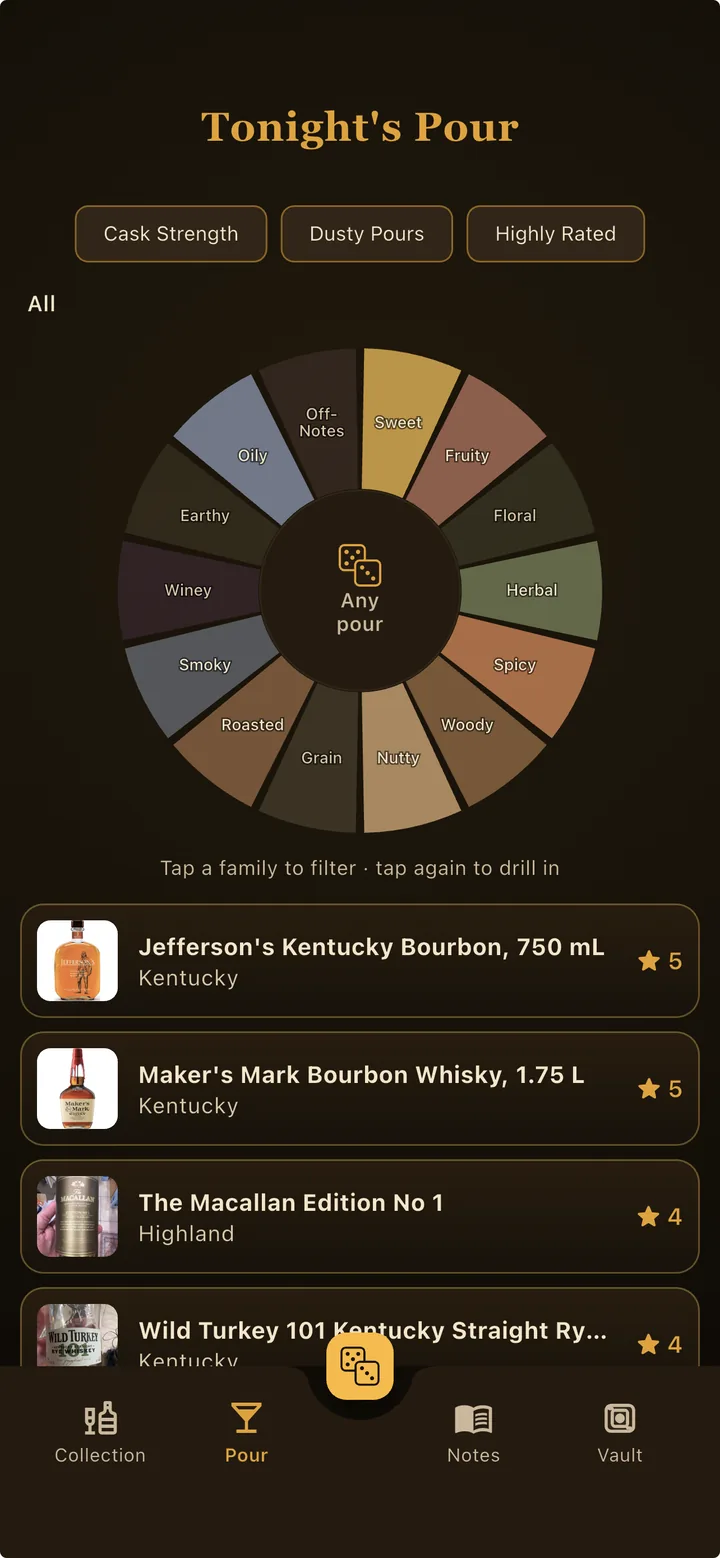
When you write a tasting note, the wheel works exactly like the ladder above: 14 families in the center, 40 groups around them, and 174 specific flavors at the rim. Tap as far out as the pour takes you, then rate each note from a hint to intense. It's free, part of the core journal.
The same wheel sits on the Pour tab, pointed the other way. Instead of describing what's in your glass, you tap what you're in the mood for — smoky, spicy, fruity — and it narrows your shelf to the bottles that fit.
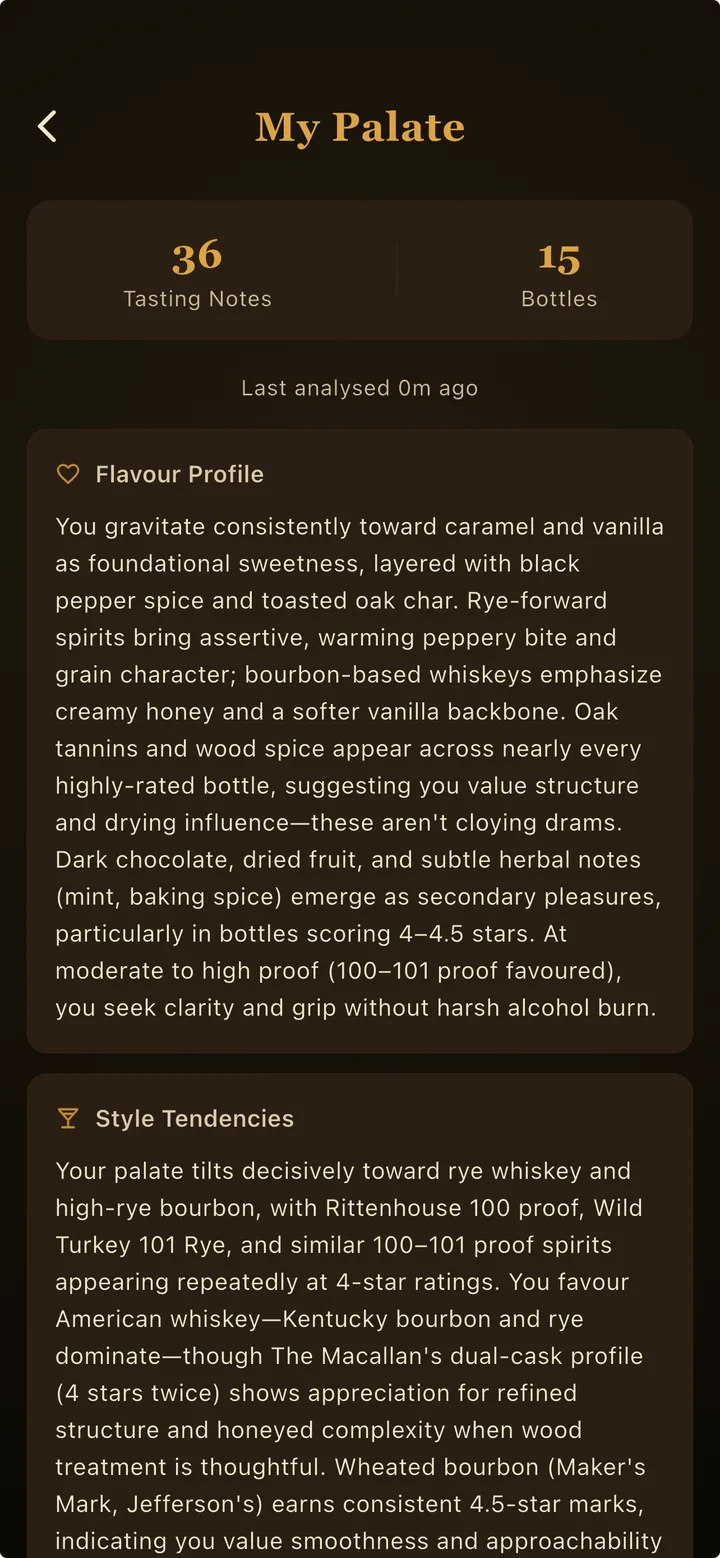
After a few dozen notes, patterns show up that are hard to spot on paper. Palate analysis, a Pro feature, reads your own ratings and notes back to you and describes what you tend to enjoy (“caramel and vanilla as a foundational sweetness, layered with black pepper spice”) and which styles keep earning your best scores.
However you use it, on paper, in the app, or taped inside a cabinet door, the rule is the one we started with. A flavor wheel is a ladder, not a test. Stand on the rung you're sure of, and climb when the pour gives you a reason to. More on how Whiskey Thief learns your palate.